
Introduction
Students often come across the term CGPA on report cards, university transcripts, admission forms, and academic result portals. However, many students do not clearly understand what CGPA means, how it is calculated, and why it is important. That is why the search for cgpa full form is very common among school, college, and university students.
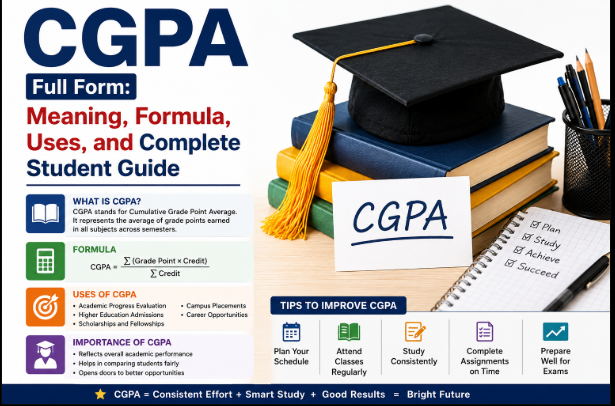
The cgpa full form is Cumulative Grade Point Average. It is a grading method used to show the overall academic performance of a student. Instead of only showing marks or percentage, CGPA presents performance in the form of grade points.
CGPA is useful because it gives a complete view of a student’s academic progress over a semester, academic year, or full degree program. It helps teachers, institutions, universities, and employers understand how consistently a student has performed.
In today’s education system, CGPA is used for admissions, scholarships, internships, job applications, and study abroad opportunities. Therefore, every student should understand the meaning, formula, benefits, and limitations of CGPA.
What Is CGPA Full Form?
The cgpa full form is Cumulative Grade Point Average.
In simple words, CGPA means the average grade point a student earns across different subjects, courses, or semesters. It is called “cumulative” because it combines multiple academic results into one final average score.
For example, if a student studies several subjects in one semester, each subject may have a grade point. When all grade points are combined and averaged, the result is called CGPA.
CGPA does not show performance in only one subject. It shows the overall academic performance of a student over a specific period. This makes it easier to understand the student’s complete academic progress.
Meaning of CGPA in Simple Words
CGPA is a number that represents a student’s academic performance. It is usually calculated on a fixed scale, such as 4.0, 5.0, or 10.0. The scale depends on the school, college, university, or education board.
For example, if a student has 8.4 CGPA on a 10-point scale, it means the student has performed well overall. Similarly, if a student has 3.5 CGPA on a 4-point scale, it also shows strong academic performance.
The main purpose of CGPA is to make results easy to understand. Instead of checking marks in every subject one by one, CGPA gives a single average score that reflects overall performance.
This is why understanding cgpa full form is important for students at every academic level.
Why Is CGPA Important?
CGPA is important because it is used in many academic and professional situations. It helps institutions quickly evaluate a student’s academic record.
Many colleges and universities check CGPA during admission. Scholarship programs may also use CGPA to select deserving students. Companies sometimes ask for minimum CGPA when hiring fresh graduates.
CGPA is commonly required for:
College admission
University admission
Scholarship applications
Internship programs
Campus placement
Job applications
Study abroad process
Academic transcripts
A good CGPA can improve a student’s chances of getting better academic and career opportunities. It also shows that the student has been consistent in studies.
However, CGPA should not be the only focus. Skills, practical knowledge, projects, communication, and confidence are also important for future success.
How Is CGPA Calculated?
The CGPA calculation method depends on the grading system of the institution. Some institutions calculate CGPA based on subjects, while others calculate it using credits.
The basic CGPA formula is:
CGPA = Total Grade Points ÷ Total Number of Subjects
For example, suppose a student gets the following grade points:
Subject 1: 8
Subject 2: 7
Subject 3: 9
Subject 4: 8
Subject 5: 10
Total grade points = 8 + 7 + 9 + 8 + 10 = 42
Total subjects = 5
CGPA = 42 ÷ 5 = 8.4
So, the student’s CGPA is 8.4.
This is the simple method. In universities, the calculation may also include credit hours.
CGPA Calculation with Credit Hours
Many colleges and universities use a credit-based grading system. In this system, each subject has credit hours. Subjects with more credit hours have a bigger impact on CGPA.
The formula is:
CGPA = Total Weighted Grade Points ÷ Total Credit Hours
Example:
Subject 1: Grade Point 8, Credit 3
Subject 2: Grade Point 9, Credit 4
Subject 3: Grade Point 7, Credit 2
Now multiply grade points by credits:
8 × 3 = 24
9 × 4 = 36
7 × 2 = 14
Total weighted grade points = 24 + 36 + 14 = 74
Total credits = 3 + 4 + 2 = 9
CGPA = 74 ÷ 9 = 8.22
So, the final CGPA is 8.22.
This method is more detailed because it gives more importance to subjects with higher credit hours.
How to Convert CGPA into Percentage
Students often need to convert CGPA into percentage for admission forms, job applications, or official documents.
A commonly used formula is:
Percentage = CGPA × 9.5
For example, if a student has 8.2 CGPA:
Percentage = 8.2 × 9.5 = 77.9%
So, 8.2 CGPA is approximately equal to 77.9%.
Another example:
If a student has 7.0 CGPA:
Percentage = 7.0 × 9.5 = 66.5%
However, every institution may not use the same formula. Some universities have their own official conversion rules. Therefore, students should always follow the conversion method given by their school, board, or university.
Difference Between CGPA and GPA
Many students confuse CGPA with GPA, but both terms have different meanings.
GPA stands for Grade Point Average. It usually shows performance in one semester or one academic term.
CGPA stands for Cumulative Grade Point Average. It shows overall performance across multiple semesters or academic terms.
For example, a student may get 8.0 GPA in the first semester and 8.6 GPA in the second semester. When both semester results are combined, the average becomes CGPA.
In simple words, GPA is semester-based, while CGPA is overall performance-based.
This is one of the most important points students should understand when learning the cgpa full form.
CGPA Grading Scale
CGPA can be measured on different grading scales. The most common CGPA scales are:
4-point scale
5-point scale
10-point scale
Many international universities use a 4-point scale. In countries like India, Pakistan, and other South Asian education systems, a 10-point scale is very common.
On a 10-point scale, a CGPA above 7 is usually considered good. A CGPA above 8 is considered very good, while a CGPA above 9 is often considered excellent.
On a 4-point scale, a CGPA above 3.0 is generally good, and above 3.5 is considered strong.
Still, the meaning of a good CGPA can change from one institution to another.
Benefits of CGPA System
The CGPA system has many benefits for students, teachers, and institutions.
First, it gives a clear overview of academic performance. A student’s overall result can be understood through one average score.
Second, it reduces the pressure of one single exam. If a student performs slightly low in one subject but does well in others, the overall CGPA can still remain good.
Third, CGPA helps in fair comparison. Students from the same class or program can be compared using the same grading system.
Fourth, it makes academic records simple. Result cards and transcripts become easier to read and understand.
Finally, CGPA encourages students to stay consistent. Since every subject and semester can affect the final CGPA, students try to perform well throughout their studies.
Limitations of CGPA System
Although CGPA is useful, it also has some limitations.
One limitation is that it does not always show exact marks. Two students may have the same CGPA but different subject-wise marks.
Another limitation is that grading systems are not the same everywhere. A CGPA of 8 in one university may not be equal to a CGPA of 8 in another university.
Some companies and institutions also prefer percentage because it looks more direct and easier to compare.
In addition, CGPA may not show practical skills, creativity, communication, or problem-solving ability. That is why students should focus on both academic grades and real-world skills.
What Is a Good CGPA?
A good CGPA depends on the grading scale and the academic program.
On a 10-point scale, a CGPA between 7 and 8 is usually considered good. A CGPA above 8 is very good, and above 9 is excellent.
On a 4-point scale, a CGPA above 3.0 is generally good. A CGPA above 3.5 is usually considered strong.
However, students should remember that CGPA is only one part of academic success. A student with good skills, projects, internships, and confidence can also achieve excellent career growth.
So, the goal should be to maintain a good CGPA while also building practical knowledge.
How to Improve CGPA
Improving CGPA is possible with proper planning and consistent effort. Students should not wait until exams to start studying. Regular study is always better than last-minute preparation.
Students can improve CGPA by attending classes regularly, taking notes, completing assignments on time, and revising lessons every week.
It is also important to focus on weak subjects. If a student improves low-scoring subjects, the overall CGPA can increase faster.
Solving past papers, practicing important questions, and discussing difficult topics with classmates can also help.
Time management plays a major role. Students should create a simple study plan and follow it honestly.
Most importantly, students should understand concepts instead of memorizing everything. Clear understanding leads to better exam performance.
CGPA and Career Opportunities
CGPA can affect career opportunities, especially for fresh graduates. Many companies check CGPA during initial shortlisting.
A good CGPA shows discipline, consistency, and academic seriousness. It can help students get selected for interviews, internships, and campus placement programs.
However, companies do not hire only because of CGPA. They also look for skills, communication, confidence, teamwork, and problem-solving ability.
For technical jobs, practical knowledge and project work are very important. For management or business jobs, communication and decision-making skills matter a lot.
Therefore, students should treat CGPA as an academic advantage, not the only requirement for career success.
CGPA and Study Abroad
CGPA is very important for students who want to study abroad. Foreign universities usually ask for academic transcripts, and CGPA is an important part of those transcripts.
A strong CGPA can improve admission chances. It can also help students apply for scholarships, assistantships, and financial aid.
Some universities convert CGPA into their own grading system. In some cases, students may need an official grade conversion report.
Students who want to study abroad should check the CGPA requirements of each university before applying. They should also prepare other documents such as statement of purpose, recommendation letters, test scores, and certificates.
Common Mistakes About CGPA
Students often make mistakes while understanding CGPA.
One common mistake is thinking that CGPA and percentage are exactly the same. They are not the same. CGPA is based on grade points, while percentage is based on marks out of 100.
Another mistake is using the wrong CGPA-to-percentage formula. Students should always check the official rule of their institution.
Some students also ignore small subjects. Even low-credit subjects can affect overall CGPA if the performance is poor.
Another mistake is focusing only on CGPA and ignoring skills. This can create problems during job interviews because employers want both knowledge and practical ability.
FAQs About CGPA Full Form
What is the cgpa full form?
The cgpa full form is Cumulative Grade Point Average. It shows the overall academic performance of a student.
What does CGPA mean?
CGPA means the average grade point earned by a student across different subjects, courses, or semesters.
Is CGPA the same as percentage?
No, CGPA and percentage are different. CGPA shows grade points, while percentage shows marks out of 100.
How is CGPA calculated?
CGPA is calculated by dividing total grade points by total subjects or total credit hours, depending on the grading system.
How can CGPA be converted into percentage?
A common formula is Percentage = CGPA × 9.5. However, students should follow their institution’s official conversion formula.
What is a good CGPA?
On a 10-point scale, a CGPA above 7 is good, above 8 is very good, and above 9 is excellent.
Is CGPA important for jobs?
Yes, CGPA can be important for fresh graduates and campus placements. But skills, internships, projects, and communication are also important.
What is the difference between GPA and CGPA?
GPA usually shows performance in one semester, while CGPA shows overall academic performance across multiple semesters.
Conclusion
The cgpa full form is Cumulative Grade Point Average. It is an important academic grading system used to measure the overall performance of students. CGPA gives a clear average score based on subjects, semesters, or credit hours, depending on the institution.
Understanding CGPA is important because it is used in admissions, scholarships, internships, job applications, and study abroad processes. A good CGPA can improve academic and career opportunities, but it should not be the only goal.
Students should focus on maintaining a strong CGPA through regular study, time management, revision, and proper planning. At the same time, they should also build practical skills, confidence, communication, and real-world experience.
In simple words, CGPA is a useful academic indicator that shows consistency and overall performance. By understanding the cgpa full form, calculation method, and importance, students can manage their studies better and make smarter academic decisions.